

I almost didn't buy the Comfytemp Red Light Belt. I'd scrolled past a dozen ads promising it would flood sore muscles with healing light and undo years of damage, and none of that language made me trust the thing. I run maintenance at a grain co-op outside town, twelve-hour shifts most days during harvest, and my hips and lower back have been stiff for years from climbing bin ladders and standing on concrete all shift. What finally got me to order one wasn't the ad copy. It was a coworker who wears his under his coat during deer season and wouldn't stop talking about it at lunch.
So I bought the Comfytemp belt with a specific goal: test the claims against reality, not just whether my back felt looser at the end of the week. Does it actually get warm the way the listing describes? Does the red glow cover as much as the product photos make it look like? Can you wear it under a work belt like a couple of the Amazon reviews suggested? I've had mine about two months now, used it close to five nights a week, and I ran a few deliberate tests along the way, timing the heat, measuring the actual panel with a tape measure, wearing it during light chores to see how it held up. Below is the breakdown, claim by claim, the parts that checked out and the parts that didn't.
The Quick Verdict
The core light therapy claims hold up better than I expected, but the coverage area and heat level are both more modest than the marketing suggests, and it's strictly an after-work tool, not something you wear on the job.
Amazon Check Today's Price →Skeptical of another red light gadget that overpromises?
I tested the actual heat and actual coverage against what the ads claim before I trusted this one. Check today's price and see for yourself what's really in the box.
Amazon Check Today's Price on Amazon →How I've Used It
My testing wasn't scientific, but it was deliberate. Most nights I strap it on around 7pm after dinner, set the 20-minute timer, and sit at the kitchen table or on the couch while it runs. That's the baseline routine, five nights a week for about eight weeks. But I also ran a handful of side experiments specifically to check the claims I was skeptical of. I timed how long it actually took to feel warm with a kitchen timer instead of guessing. I laid the belt flat and measured the lit panel with a tape measure against what the packaging photos implied. And I wore it, unplugged obviously, under my work belt for a shift just to see if the fit claim some reviewers made held up.
I also took my nephew Cody's opinion into account, since he's twenty-six and skeptical of basically everything that isn't backed by a study, and he sat through a couple sessions with me giving his own commentary. Between the two of us picking it apart, I think I got a fairer read than if I'd just strapped it on and reported back how I felt a month later.
I kept a running note on my phone the whole two months, not scores like a mood tracker, just plain observations after each session. Felt warm by minute seven tonight. Panel definitely doesn't reach the hip. Forgot I had it on until the timer clicked off. Little notes like that add up over eight weeks into a pretty honest picture, and it's a lot harder to talk yourself into believing something worked when you've got dated notes contradicting the rosier memory you'd otherwise settle on.
The Heat Claim vs What You Actually Feel
The listing and a lot of the marketing photos make it look like this thing runs hot, the kind of deep heat you'd get from a professional heating pad on its highest setting. That's not what I felt. Timing it with my phone, it takes roughly six to eight minutes before you notice any real warmth building, and even at the twenty-minute mark it tops out somewhere around a medium setting on a standard heating pad, not the high setting. It's a mild, steady warmth, not the kind that makes you want to peel a layer of clothing off.
For me that's actually fine, because I don't want to fall asleep with something scorching hot against my skin. But if you're buying this specifically expecting an intense heat therapy session on top of the light, temper that expectation now. The heat is a secondary, comfortable side effect. The red and near-infrared light is the actual mechanism doing the work, and it doesn't need to be hot to function, the warmth you feel is mostly just a byproduct of the LEDs running for twenty minutes, not a separate heating element cranked up for effect.
Coverage: What the Product Photos Don't Show You
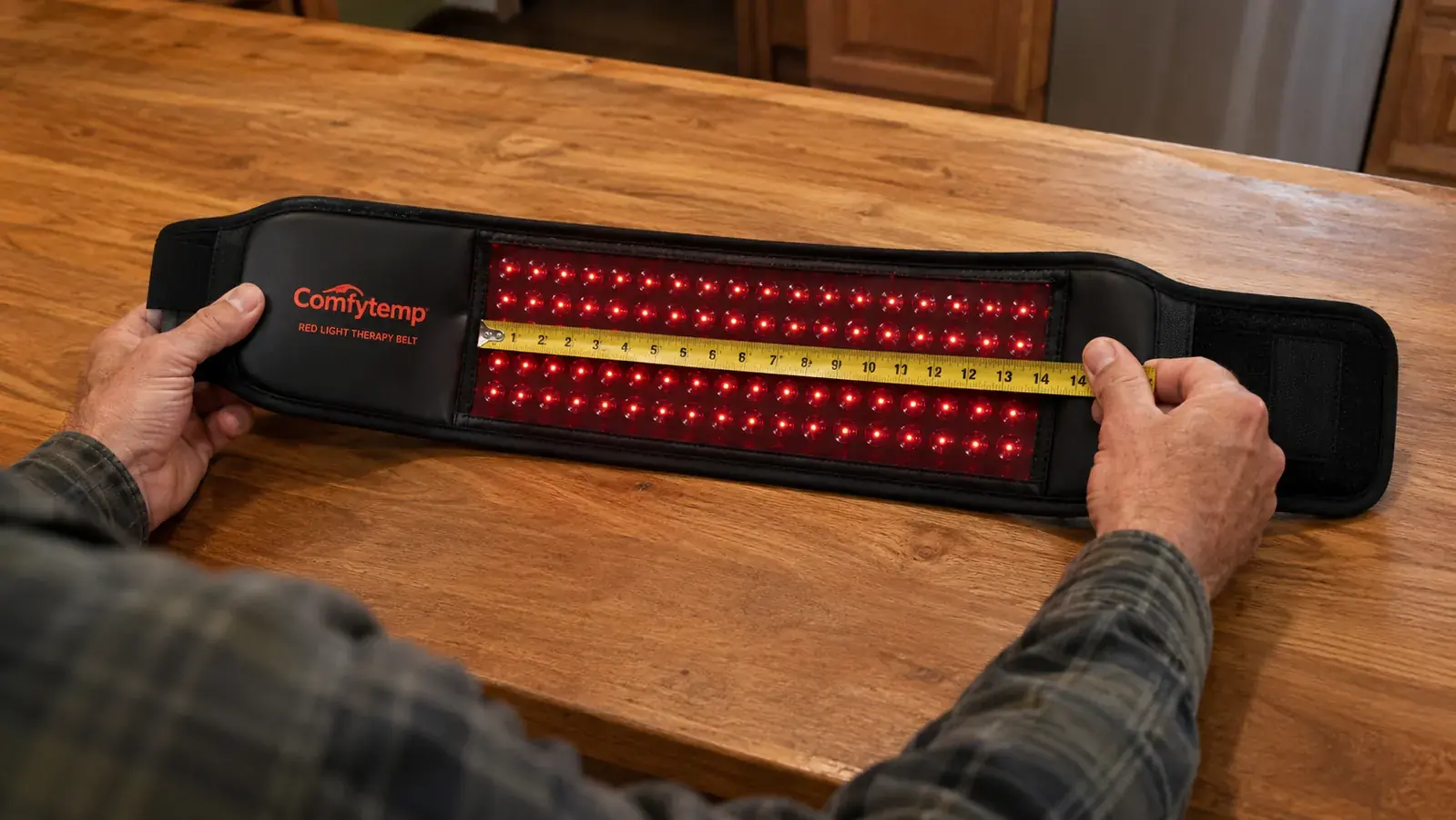
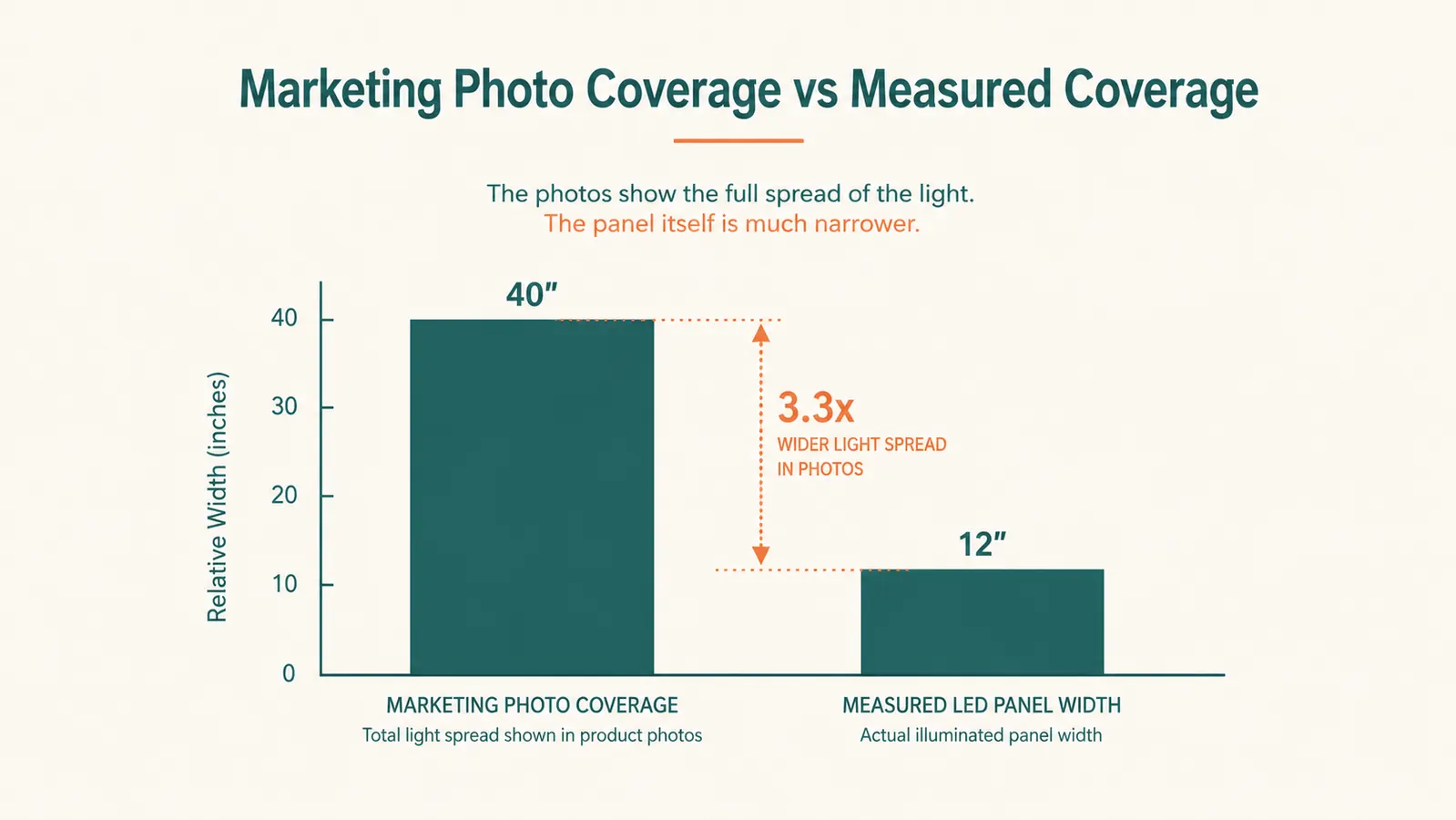
This is the part that annoyed me most, so I broke out a tape measure. The lit panel on the belt measures roughly nine inches wide by five inches tall once you account for the fabric border around the actual LEDs. In the marketing photos, with the belt wrapped around a slim model and shot from an angle, it reads like it wraps most of the way around the torso. It doesn't. It's a rectangle that sits centered on your lower back, and once you're wearing it at a normal size, there's plainly a lot of belt on either side that isn't lit up at all, just strap and closure.
For a straight lower-back complaint, centered right where your spine meets your hips, that panel size is genuinely enough, and I'm not going to pretend it isn't. But if you're picturing something that wraps around and hits both hip flexors or reaches up toward your mid-back like the lifestyle photos imply, you're going to be disappointed. I'd call this an honest limitation, not a dealbreaker, but it's exactly the kind of thing that should be stated plainly instead of left to a blurry lifestyle photo to imply otherwise.
I Tried Wearing It Under a Work Belt. Here's Why That Doesn't Work
A few reviews online mention wearing similar belts discreetly during the day, so I tried it, unplugged of course, since it's corded and there's no battery mode. I wore the Comfytemp belt under my tool belt for about two hours on a slow morning to see how it felt just as a physical layer, not lit up. It's thicker than I expected, closer to a lumbar support belt than a thin wrap, and having a second belt layer under my actual tool belt bunched up at the hips within the first half hour. It also made bending down to grab tools noticeably more awkward, since the extra bulk shifts when you flex forward.
Even setting the bulk aside, the cord makes the whole idea a non-starter. There's no way to run this while you're moving around a job site, climbing a ladder, or operating equipment, because it needs to stay plugged into a wall outlet the entire session. Anyone telling you they wear this productively during a work shift is either exaggerating or talking about a completely different, battery-powered device. This one lives in the after-work window, full stop, and I'd rather a company just say that plainly instead of letting five-star reviews imply otherwise.
The Timer and Cord Length Nobody Mentions
Two practical details caught me off guard that I never saw mentioned in any review before I bought it. First, the auto-timer only runs in fixed increments, you don't get to dial in an odd number like fifteen minutes, you're choosing between the preset options and living with it. That's a minor gripe, but if you were hoping to customize session length precisely, you can't. Second, the power cord itself is shorter than I expected, somewhere around five feet from the belt to the plug. That's fine if your couch or recliner sits near an outlet, which mine does, but it ruled out using it in my armchair on the other side of the living room without an extension cord.
Neither of these is a serious flaw, but they're the kind of small friction points that shape whether you actually use something consistently or let it drift into a drawer. Map out where you'll realistically sit for twenty minutes a night before you buy, and make sure it's near a plug, because you're not going to want to drag a chair across the room every evening just to use it.
What It Actually Costs to Run
Nobody talks about this part either, so I did the math since I'm the type who checks. At 22 watts and roughly 20 minutes a session, five nights a week, you're looking at pennies a month in electricity, not even worth mentioning next to what a single chiropractor visit or massage session runs. There's no consumable to replace either, no gel packs, no pads that wear out, no batteries to buy. Compared to the ice-heat-ice routine I used to run with a bag of frozen peas and a plug-in heating pad that died on me twice in three years, this has been cheaper to keep running than what it replaced.
That's not a reason by itself to buy it, plenty of cheap things aren't worth owning. But it does mean the ongoing cost argument against it doesn't really hold up once you already own it. The bigger question is whether the light itself is doing enough work to justify the upfront cost, and that's a fair question I can't answer for someone else's back, only my own.

Two Months In: Does It Actually Help
Setting the marketing gripes aside, the honest answer is yes, modestly, and only with consistent use. My hips and lower back are noticeably less stiff getting out of the truck after a long shift than they were two months ago. I still feel worked over after a hard day on the bins, that hasn't changed and I never expected it to. What's changed is how long the stiffness lingers into the evening. It used to take me a good hour of moving around before I loosened up after work. Now it's closer to twenty minutes, right about the length of one session.
Cody, my skeptical nephew, admitted after week three that his own shoulder felt looser on the nights he sat through a session with me, though he still thinks half of it is just sitting still and relaxing for twenty minutes regardless of the light. He might be right, and I can't rule that out from my own experience either. What I can tell you is that whatever the mechanism, red light, near-infrared, mild heat, or just the forced twenty minutes of sitting down, the combination has earned a permanent spot in my evening routine, and that's more than I can say for most things I've bought off an ad.
One more honest note on safety, since I've read some odd claims about red light devices online. I haven't had any skin irritation, marks, or redness after a session, even on nights I've fallen asleep with it on past the timer's shutoff. I'm no doctor, and this isn't medical advice, so if you're on medication that makes you photosensitive or you've got a skin condition, run it by your doctor before strapping any light device to your back. For a regular guy with regular skin and no complications, two months in, I haven't had a single issue.
What I Liked
- Light and warmth genuinely do something, my stiffness recovery time noticeably shortened over two months
- Both 660nm and 850nm wavelengths in one panel, no need to buy two separate devices
- Auto-timer prevents overuse and shuts off on its own, good for a guy who forgets he's wearing it
- Straightforward setup, no app, no pairing, no learning curve
- Cheap to run daily, no consumables and negligible electricity cost compared to regular chiropractor visits
Where It Falls Short
- Coverage area is meaningfully smaller than the marketing photos suggest, roughly nine by five inches lit
- Heat is mild, not the intense warmth implied in some listing photos
- Cord is short, around five feet, and there's no battery version
- Cannot be worn productively during work or any activity that requires moving around
- Timer only offers preset lengths, no custom duration
The light does something real. It just doesn't do as much of the room as the pictures make you think.
Who This Is For
If your pain sits squarely in the lower back, right at the belt line, and you want an honest, hands-free evening routine near a couch or recliner with an outlet nearby, this fits well and the coverage limitation won't matter much because it's already aimed right where you need it. It's also a solid pick for someone who read the marketing, was skeptical like I was, and wants a device that under-promises once you know what you're actually getting rather than one that oversells itself on the box. If you're already comparing it to the ongoing cost of regular chiropractor visits or massage appointments, the math works out in its favor pretty fast.
Who Should Skip It
Skip this if you were sold on the idea of wearing it discreetly during a shift, hunting sit, or long drive, because the cord makes that impossible and the bulk makes it uncomfortable under a work belt even unplugged. Skip it too if the sore spot you're chasing is wider than a straight strip across the lower back, both hips at once, mid-back, anything spread out, since the panel simply doesn't reach that far no matter how the photos frame it. And if you're expecting intense heat on par with a max-setting heating pad, look elsewhere, because this runs mild by design and that's not going to change no matter how long you leave it on. If you have a photosensitivity condition or you're on medication that affects it, check with your doctor before adding any red light device to your routine.
Now you know exactly what you're getting, heat, coverage, and all.
No exaggerated claims here, just what I measured and felt over two months of honest use. If a straight lower-back panel with real light therapy and mild warmth fits what you need, check today's price on Amazon.
Amazon Check Today's Price on Amazon →