

Shiatsu massager sessions only do their job if you stop treating them like something you grab when your neck's already screaming and start treating them like part of the shift wind-down, same as hanging up your tool belt. I run maintenance at a plant outside Waco, and most of my day is spent with my chin tipped back staring up at overhead crane rails, catwalk bolts, or HVAC ductwork strung above the press line. Do that for twenty-six years and your neck and traps start keeping score.
By the time I clock out, turning my head to check the mirror on the drive home feels like a decision my body has to think about. I tried stretching it out on my own for a while, and that helped some, but it wasn't until I built an actual routine around a Nekteck shiatsu neck and shoulder massager that the tightness stopped winning most nights. This isn't the review, I've written that one separately. This is the actual step-by-step of how I use it to knock down neck and shoulder tension after a day that's been rough on my upper back. Five steps, nothing complicated, and every one of them I figured out by doing it wrong first.
Your Neck Isn't Going to Loosen Itself Up
If you're looking up, reaching overhead, or hunched over a bench all day, a shiatsu massager isn't a luxury, it's maintenance for the parts of you that don't come with a replacement part. Here's the one I run most nights.
Amazon Check Today's Price on Amazon →Step 1: Use It Within an Hour of Clocking Out, Not Right Before Bed
Timing matters more than people think. I used to save the Nekteck massager for right before bed, figuring I'd wind down with it after everything else was done. Problem is, by nine o'clock my neck had already been locked up for six or seven hours, and a fifteen-minute session at that point was just loosening something that had already set like concrete.
Now I use it the second I walk in the door, still in my work boots half the time. Carla will tell you she's watched me sit at the kitchen table with the massager draped over my shoulders while she's got dinner going, looking ridiculous, and I've made my peace with that. Hitting the tension while it's still fresh, before it has all evening to set, makes a real difference in how loose I feel by the time I actually sit down for the night.
If your shift ends and you've got a drive home first, that's fine, just don't let more than an hour or two pass before you get to it. The nodes work on knots that are still workable. Wait too long and you're fighting a knot that's had all evening to settle in and get comfortable.
Weekends are trickier since I'm not clocking out of anything, but the same rule holds. After a morning splitting wood or a long sit in a tree stand with my neck cranked at an angle, I use it as soon as I'm back at the truck if I can swing it, plugged into the cigarette lighter adapter on the drive. Waiting until I'm home and settled just gives the tightness another hour or two to dig in before I ever get to it.
Step 2: Position the Nodes on the Base of Your Skull and Traps, Not Wherever It Lands
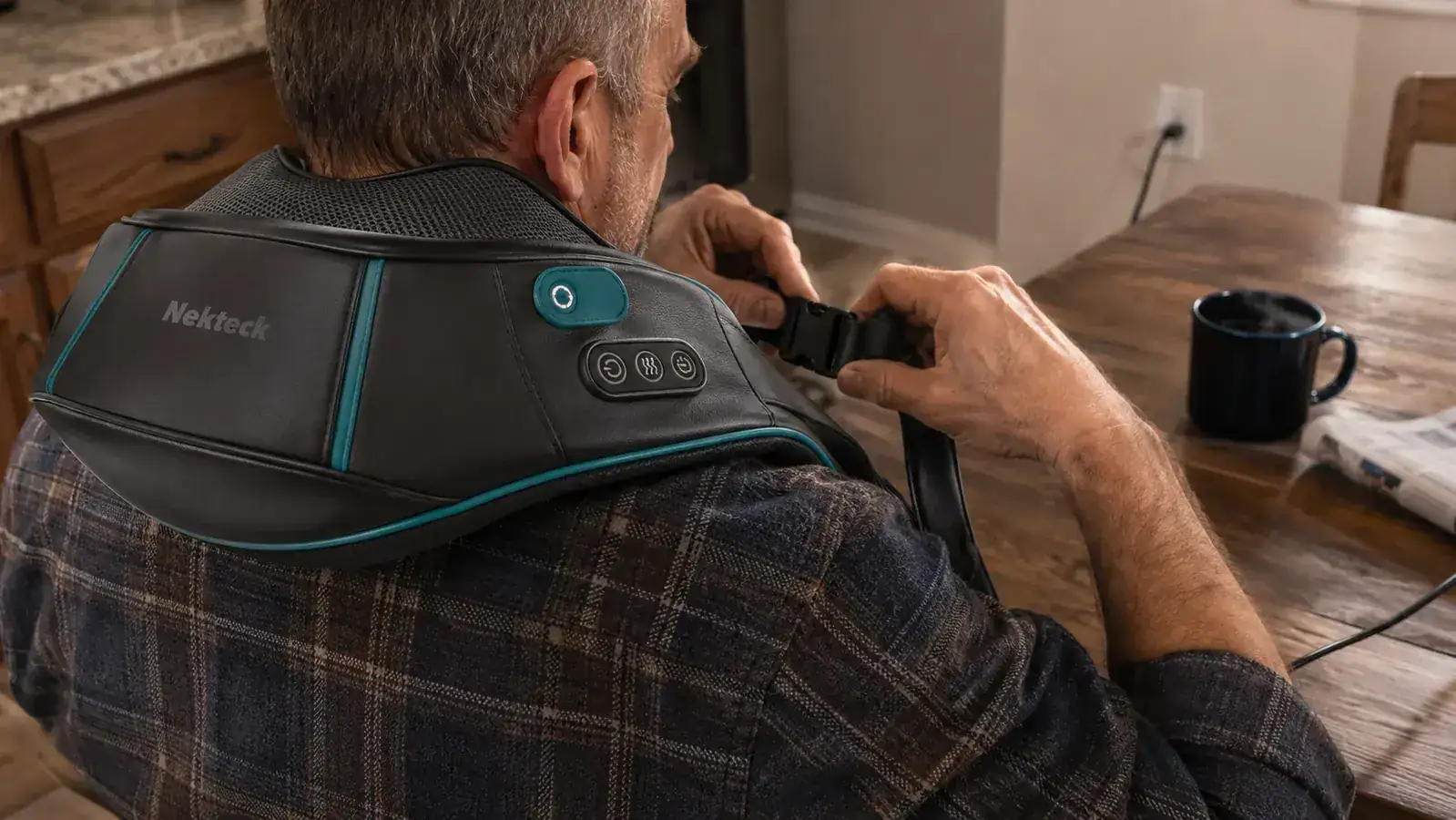
The Nekteck has a U-shaped collar that drapes over your shoulders, and it's tempting to just throw it on and let it sit wherever it falls. That's a mistake I made for the first couple weeks. The tension that builds up from looking up all day sits mostly in two spots, right where your skull meets your neck, and across the top of your traps where your shoulders and neck meet.
I adjust the collar so the nodes land right at the base of my skull for the first few minutes, since that's where the worst of my headaches start on a bad day. Then I shift it down an inch or two so the nodes work the traps themselves. It only takes a second to reposition, and it's the difference between a session that feels pleasant and one that actually gets into the spot that's been bothering you all shift.
Don't be afraid to move it around mid-session either. I'll usually reposition twice in a fifteen-minute stretch, chasing whichever spot is barking the loudest that particular day. Some days it's all skull base, other days it's mostly the traps from wrenching overhead.
I also learned not to just center it and forget it. If you only ever run it dead center on your neck, you'll miss the trap on whichever side takes the worst of the day's work, and for me that's almost always the right side from favoring one arm on overhead jobs. Shifting the collar an inch toward that side some nights makes a bigger difference than anything else I do.
Step 3: Turn the Heat On, But Give It a Minute Before You Judge It
The heat function on this thing isn't instant, and I almost gave up on it the first week because I kept turning it on and off, thinking it wasn't doing anything. Give it a solid minute or two before you decide whether the heat setting is worth using. Once it's actually warmed up, it makes a noticeable difference in how quickly the kneading nodes work through a tight spot.
I run the heat every single session in the colder months, since a stiff neck and a cold plant floor don't mix well. In summer, after I've already been sweating outside half the day, I'll skip the heat and just run the kneading on its own. Neither way is wrong, it depends on whether your muscles are already warm or need the extra help getting there.
One thing I'd tell you straight, don't fall asleep with the heat running against your skin for a long stretch. I dozed off once with it on my shoulders and woke up with a spot that was a little too warm for comfort. Not dangerous, just uncomfortable, and it's an easy mistake to avoid once you know it's coming.
I also pay attention to how my skin's holding up, since running heat on the same two or three spots every night for months can leave things a little more sensitive than they used to be. Nothing serious, just something worth watching. If a spot feels irritated instead of just warm, I'll skip the heat there for a night or two and let it be.

Step 4: Pair It With Two Minutes of Actual Stretching, Not Just the Machine
The massager does the heavy lifting, but it works a lot better when you don't ask it to do the whole job by itself. Before I even turn it on, I'll do a couple of slow neck rolls and pull my ear toward my shoulder on each side, holding for about twenty seconds. That loosens things up just enough that the massager's nodes can actually get into the muscle instead of working against a joint that's still fully locked.
After the session, I do the same stretch again. It's a small thing, maybe ninety seconds total, but it locks in whatever the massager just loosened up. Skip this step and you'll still feel better right after using it, but that looseness fades faster, sometimes within an hour or two.
I picked this habit up from watching how physical therapists talk about heat and massage, they almost never treat either one as a standalone fix. A shiatsu massager is a tool that works with movement, not instead of it, and treating it that way is what made the difference for me.
On nights when I'm especially locked up, I'll add a slow chin tuck, pulling my head straight back like I'm trying to make a double chin, and holding it for ten seconds a few times. It sounds silly standing in the kitchen doing it, but it targets the exact muscles that get shortened from looking up all day, and it's the one stretch that makes the biggest difference on the worst nights.
Step 5: Make It a Nightly Habit for Two to Three Weeks Before You Judge It
The first time I used the massager, I expected it to fix a neck that had been getting worse for over two decades in one fifteen-minute session. It didn't, and if you walk in with that expectation you'll be disappointed and probably shelve it after a week like I almost did.
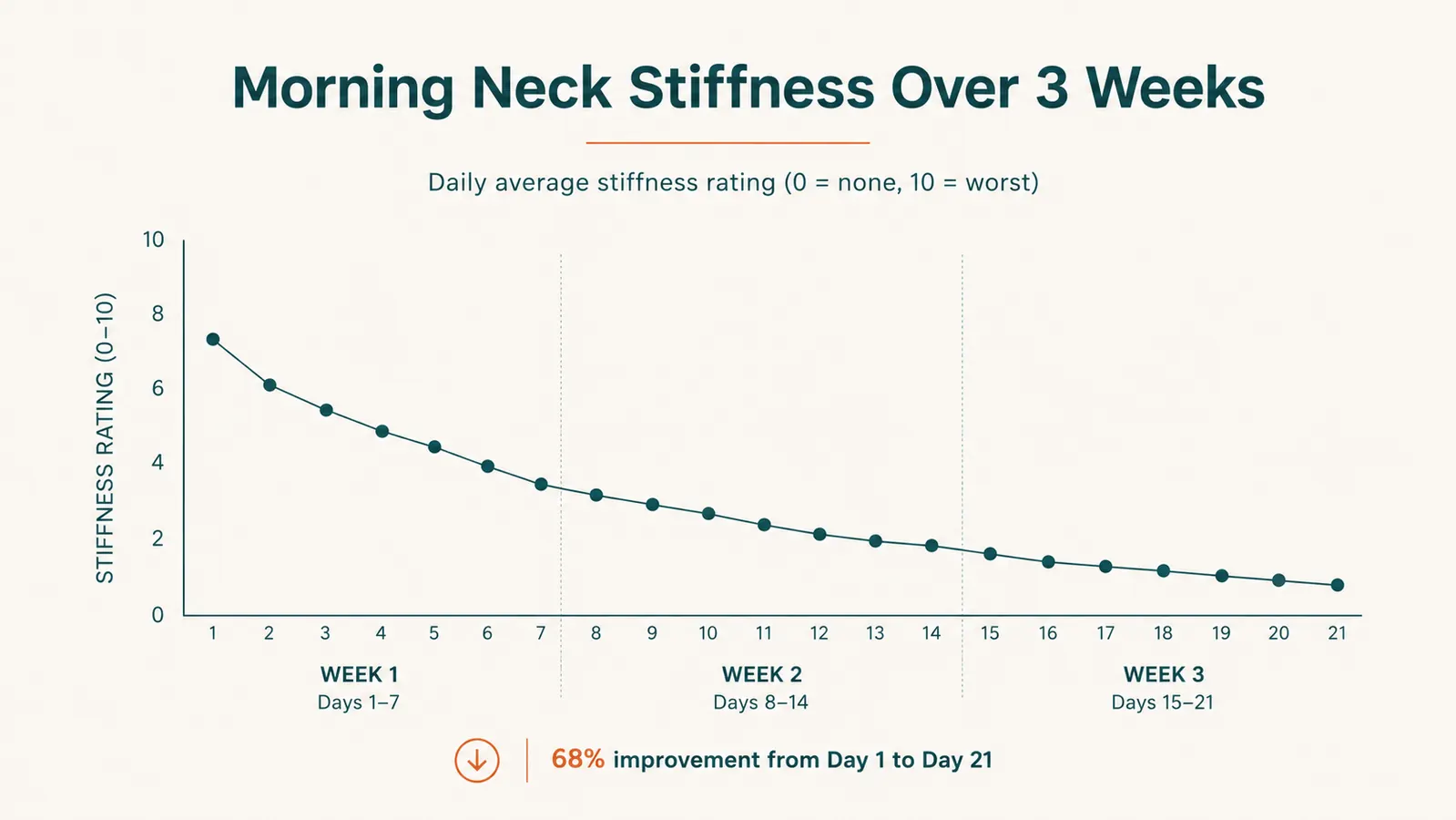
What actually worked was using it most nights, or close to it, for about two to three weeks straight. Somewhere around day ten I noticed I wasn't reaching for ibuprofen in the truck's glovebox nearly as often. By week three, turning my head to check blind spots didn't feel like a negotiation anymore.
I still use it most nights now, four months of daily wrenching later. It's become as automatic as hanging up my tool belt when I walk in the door. If you use it twice and decide it's not for you, you never actually gave it the chance to do its job.
I started keeping a rough mental note of how stiff I felt first thing in the morning, nothing scientific, just a number in my head from one to ten. Watching that number drop over a few weeks did more to keep me consistent than any amount of feeling better in the moment, because some nights you don't notice the difference until you look back at where you started.
What Else Helps
The massager handles the day-to-day maintenance, but a couple other things make a real difference too. I keep my station at the plant set up so I'm not craning my neck upward any more than the job actually requires, even if that means grabbing a step stool instead of tilting my head back for ten minutes straight. I also stopped sleeping on my stomach a while back, since that twists your neck sideways for six or seven hours and undoes half of what the massager fixed the night before. And on weekends, whether I'm at the lake or up in a tree stand, I bring a small travel pillow for the ride home, because a long drive with your head cocked to one side after a day outdoors will erase a week of progress in an afternoon.
I also watch how much water I'm drinking through a shift, since being dehydrated makes everything tighten up faster, neck included. And I've gotten more particular about the pillow I sleep on, since a pillow that's too flat or too thick undoes a lot of what the massager fixes the second you lay your head down wrong for eight hours.
A massager sitting in a drawer doesn't fix anything. Mine earns its keep because I actually use it, on purpose, most nights.
Give Your Neck the Same Attention You Give Your Truck
You wouldn't ignore a squeal from your truck for four months and expect it to fix itself. Your neck's no different. This is the massager I've leaned on every night for four months straight.
Amazon Check Today's Price on Amazon →